
Why periodisation is not just for athletes — and what it actually means to train smart
Updated: Apr 2
Periodisation
Periodisation is a word that comes from sport science. It describes the practice of structuring training across time — varying intensity, volume, and recovery in a deliberate sequence so that the athlete is neither chronically overloaded nor under-stimulated. It is how high-performance sports programmes have been designed for decades.
For a long time, this kind of intelligence was applied almost exclusively to male athletes. The physiology being studied, the training models being built, the protocols being tested — they were largely built around a 24-hour hormonal cycle. One that is not how most female bodies work.
What periodisation offers women — and why the conversation around cycle awareness matters even when it gets co-opted by trend — is a framework for acknowledging the obvious: that the body changes across the month, that those changes affect training capacity, and that applying identical load every single week is not smart programming. It is a refusal to look at the evidence.
The problem with constant intensity
Most of the women I work with arrive training hard. They are consistent, disciplined, and genuinely invested in their health. They are also often exhausted in ways that training harder has not fixed.
The issue is rarely their commitment. It is the absence of variation. When load stays the same week after week — same intensity, same volume, same expectation of output — the body loses the contrast it needs to adapt and recover. Progress slows. Energy becomes unpredictable. Minor niggles do not resolve. The session that used to feel good starts to feel like something to get through.
This is not burnout in the dramatic sense. It is the quiet accumulation of a system that has not been given space to consolidate what it has been building.
Adding cycle awareness to this picture is not about following a prescriptive schedule of yoga in the luteal phase and heavy lifting in follicular. That framing — which has become very popular online — strips the nuance entirely. What it is about is understanding that training load does not exist in isolation. It sits alongside professional load, family load, sleep, nutrition, stress, and a hormonal environment that shifts continuously. All of it counts.
What intelligent variation actually looks like
In practice, training smarter rarely means training less. It means making better decisions about when to push and when to consolidate.
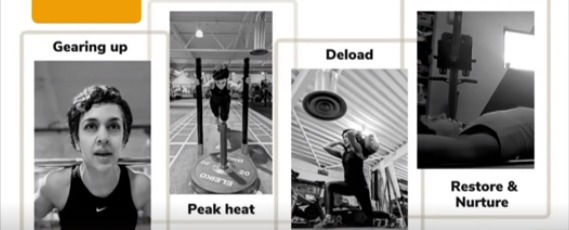
In the follicular phase, rising oestrogen tends to support higher-intensity work, faster recovery between sessions, and greater neuromuscular drive. This is often a good window for heavier lifts, higher volume, and more demanding conditioning. In the luteal phase, progesterone rises and body temperature increases slightly. Recovery slows. Cognitive load often increases. This is not a week to abandon the gym — movement remains important — but it may be a week to adjust. Shifting from free weights to machines removes stability demand and keeps heart rate lower. Choosing moderate intensity over maximum effort. Training to a seven rather than a ten.
These are not large changes. But compounded across months, they create a very different training experience: one where the body is not fighting the programme, but working with it.
The same logic applies to women on hormonal contraception who may not experience the same cyclical fluctuation. Periodisation still matters. The argument is not about hormones specifically — it is about the intelligence of variation. Applying the same load every week, regardless of what else the body and nervous system are managing, will eventually cost something.
ADHD, load management, and why this is harder than it sounds
There is a particular challenge here for women with ADHD, which is something I speak about from personal experience as well as professional practice. The ADHD brain often operates in extremes — full capacity or nothing. The idea of a moderate session, of intentionally pulling back when the energy is high, can feel counterintuitive. The body is up for it. Why would you not go for it?
Because the nervous system is also managing everything else. Because the high-energy days often follow poor sleep or high cognitive demand. Because the crash after consistently pushing at full force is not hypothetical — it is a pattern that eventually interrupts the training entirely.
Learning to manage load intelligently is, in many ways, more a cognitive and nervous system skill than a physical one. It requires the capacity to sit with the discomfort of doing less than you could. To choose the long game. That takes practice.
The curiosity required
None of this works without a willingness to look. Not at a trend, not at a rigid programme, but at your own body and your own patterns. Tracking symptoms across the month — energy, focus, recovery, mood — over even two or three cycles begins to reveal a picture that is specific to you. That information is far more useful than any generic phase-based protocol.
The women who get the most from this kind of approach are not the ones who follow it perfectly. They are the ones who stay curious about what their body is actually telling them, and who are willing to adjust when the data and the lived experience do not match the plan.
Training smarter is not about doing less. It is about paying enough attention to do the right thing at the right time. That is a skill. And it is one worth building.
If you are an active woman in your thirties or forties who trains consistently but feels like something is off — energy, recovery, focus, or all three — you might benefit from working with a coach who understands the full picture. I work with women in person in South East London and online. More details can be found here.



Comments