
Why Perimenopause Changes How You Need to Train — And Recover

Perimenopause does not arrive as one thing. It arrives as many things at once — anxiety that seems to come from nowhere, unexplained weight changes, sleep disruptions, a sudden intolerance for stimulation that you used to absorb without blinking. And for women who have built their lives around high output and high capacity, it can feel like the ground has shifted.
The women I work with are not sedentary. They train, they move, they know their bodies. But perimenopause asks something different of them. It asks them to understand not just how to train hard — but how to train in a way the nervous system can actually support.
What Changes During Perimenopause
Oestrogen is not just a reproductive hormone. It plays a significant role in nervous system regulation, mood stability, cardiovascular function, bone density, and recovery capacity. As oestrogen begins to fluctuate and eventually decline in perimenopause, all of these systems are affected.
For active women, the most commonly reported changes are: energy that is inconsistent rather than reliably available, a reduced tolerance for stress (mental or physical), heavier periods leading to iron deficiency, disrupted sleep, and a body that no longer responds to the old strategies — the cutting, the pushing through, the burning more and eating less.
One of my clients described trying to apply the same approaches she had used before perimenopause and finding that nothing worked. Her body simply did not respond the way it once had. She was not doing anything wrong. The context had changed.
Training Through the Cycle in Perimenopause
Cycle syncing — training in alignment with where you are hormonally — is well established in the research and even more relevant during perimenopause, when those cycles become less predictable.
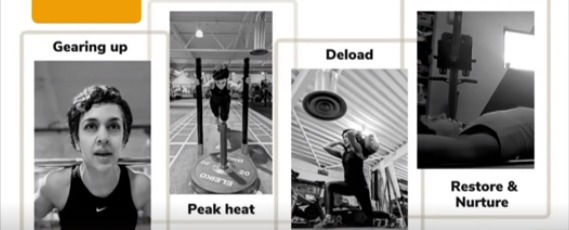
What my clients consistently discover is that their capacity varies significantly across the month. What feels effortful in one phase feels fluid in another. Rather than overriding that variation with uniform intensity, we map it. We train harder when the body is primed for it, and we train more restoratively when it needs that instead.
This is not training less. It is training more intelligently.
Interestingly, the follicular phase and the bleed itself — phases women often assume are low-capacity — can be some of the strongest training windows. One of my clients was surprised to find she lifts her heaviest weights during her period. The relief of the bleed, the drop in the premenstrual hormonal surge, can leave women feeling clearer and more physically able than they expected.
Ovulation, by contrast, which used to feel like a high point — the shiny-hair, ready-for-anything phase — can become destabilising in perimenopause. The hormonal spike that previously felt energising can tip into anxiety, anger, or exhaustion. Knowing that this is a phase to move through, rather than a sign that something is wrong, changes how a woman relates to it.
The Nervous System Piece
The conversation about perimenopause and training almost always needs to include the nervous system. This is where I see the most significant gap between how women approach exercise and what their bodies actually need.
Many women arrive to training still in a high-activation state — cognitively busy, emotionally loaded, running on stimulants and schedule. The training session then adds further demand to a system that is already at capacity. The result is that training becomes another stressor, rather than a release from stress.
The practice I use is to begin every session by bringing the nervous system down first. Breath work. Lying down. Gentle mobility. Not as a soft option, but as a precondition for the work that follows. When the nervous system settles, the body becomes available. Strength that felt inaccessible five minutes earlier is suddenly there.
For women in perimenopause — where the window between regulated and overwhelmed has narrowed — this is not an optional extra. It is the foundation.
Recovery Is Not a Reward
One of the most important reframes I work with is the idea that recovery is not what you earn by training hard. It is what makes training meaningful in the first place.
Practically, this might look like: prioritising sleep above additional sessions, building in true rest days rather than active recovery that is really just lighter exercise, eating enough protein to support muscle repair and hormonal health, and recognising that socialising, caregiving, and cognitive work all draw from the same energy reserves as physical training.
My clients who manage perimenopause most effectively are the ones who stopped trying to solve it with one thing. Higher protein. Better sleep. Strength training that respects the cycle. Time alone. Supplementing where blood tests show deficiency. Cold water. Boundaries.
None of these in isolation is the answer. Together, they constitute a system — and the body responds to a system.
What This Means in Practice
If you are a woman in perimenopause who trains, the most useful question is not whether you are training hard enough. It is whether your training is building your capacity or eroding it.
A session that leaves you feeling depleted for two days is not a sign you worked hard. It is information. The body is telling you something about timing, about intensity, about what it needed in that window.
Strong, sustainable training in perimenopause is available. It just requires a different relationship with effort — one that is less about pushing through and more about precision.
If you are navigating perimenopause and wondering how your training needs to shift, I work with women in exactly this transition. My 1:1 spaces in South East London and online are open. More details can be found here.
Coming Up | When Pain Speaks
On Thursday 21 May, I'm hosting When Pain Speaks — a clinical and somatic symposium at Beckenham Place Mansion, London (and online via Zoom).
Joined by a Pain Specialist Physiotherapist and a Yoga Therapist-Psychotherapist, we'll be exploring what pain is really trying to communicate — and what becomes possible when we finally listen.
7:00–8:30pm | In person or online | Recording included | Tickets £65
Listen to Emma's experience of perimenopause here:



Comments